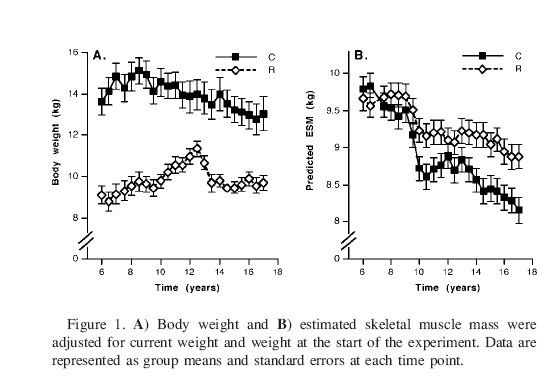
Well according to that abstract it significantly slows the decline. We see the same with various hormones, and bone with CR too. Start off at a lower level, but the decline is much slower.
There was an interesting study a little while back on rodents. An article states;
"Scientists from the University of Calgary found that rats fed a nutritious, calorie-restricted diet maintained their muscle mass much better than rats that ate a normal amount of food. "It's the equivalent of an 80-year-old rat with the muscles of a 20-year-old rat," said Russ Hepple, a physiologist at the University of Calgary."
Source
It seems very likely the same effect will be seen in humans. The fact that CR preserves muscle mass is very nice because not only could we expect to be more functional with age, but also have much less chance of bone fracture. People with better muscle function and mass tend not to be as susceptible to falls as old frail people with poor muscle function, co ordination... Even at 18y the CR group had a higher ESM than the ad lib group at 10 years!
Heres a direct link to the graph from the paper
Attenuation of sarcopenia by dietary restriction in rhesus monkeys.
Colman RJ, Beasley TM, Allison DB, Weindruch R.
Wisconsin National Primate Research Center, University of Wisconsin-Madison, 1220 Capitol Ct., Madison, WI 53715. rcolman@primate.wisc.edu.
Sarcopenia, the loss of muscle mass with normal aging, devastates quality of life-and related healthcare expenditures are enormous. The prevention or attenuation of sarcopenia would be an important medical advance. Dietary restriction (DR) is the only dietary intervention that consistently extends median and maximum life span, as well as health span in rodents. Evidence suggests that DR will have a similar effect in primates. Furthermore, DR opposes sarcopenia in rodents. We tested the hypothesis that DR will reduce age-related sarcopenia in a nonhuman primate. Thirty adult male rhesus monkeys, half fed a normal calorie intake and half reduced by 30% in caloric intake, were examined over 17 years for changes in dual-energy X-ray absorptiometry-estimated skeletal muscle mass. Body weight-adjusted skeletal muscle mass declined somewhat in both groups but was far more rapid in the control group. We have shown that moderate, adult-onset DR can attenuate sarcopenia in a nonhuman primate model.
PMID: 18559628 [PubMed - in process]
Saturday, June 21, 2008


Friday, June 20, 2008
Exercising again
It's been 8 months since I took cipro and my tendons are pretty much able to withstand exercise now. The doctor told me that it would take 3 weeks for my tendinitis induced by ciprofloxacin to heal, however it actually has taken 32 weeks!!!
But anyway, I'm back to doing yoga twice a week with 1 hour each session. I am practicing my Katas ready to go back to Karate in a couple months. I am also able to run now, just the other day I ran 5 miles straight without any problems, and actually even though I haven't done this sort of running in over 8 months I didn't feel unfit? LoL. I am also rebuilding my strength back up with my free weights. I'm using a pretty low weight right now but will work up very slowly to avoid further injury. Anyway thats it for this post... looks like I might be definitely fully restored by 12th month mark :)
But anyway, I'm back to doing yoga twice a week with 1 hour each session. I am practicing my Katas ready to go back to Karate in a couple months. I am also able to run now, just the other day I ran 5 miles straight without any problems, and actually even though I haven't done this sort of running in over 8 months I didn't feel unfit? LoL. I am also rebuilding my strength back up with my free weights. I'm using a pretty low weight right now but will work up very slowly to avoid further injury. Anyway thats it for this post... looks like I might be definitely fully restored by 12th month mark :)
Friday, June 06, 2008
Resveratrol in the News
I guess we've all heard the resveratrol news by now... but am I taking it?
No I'm not. I think it is a little risky taking resveratrol in huge quantities when I'm already doing CR anyway. Sure it might enable the maximum benefit of CR, but on the other hand it could actually prevent CR from slowing down aging. It will be probably take years of more data on CR + Reseveratrol for me to even consider taking it long term. I don't drink red wine either, but was following a discussion the other week on red wine and CR... and how they might be synergistic. I kind of follow MR's point now when I think about it, sure red wine has pretty good evidence behind it, and thats why he and others choose to drink it, so one should maybe include it in their diet. The argument, which I also believed a year or so ago was that would the small amount of resveratrol in red wine actually contribute ANYTHING at all to a CR diet in reducing disease risk further. But then Michael brought up the broccoli argument. It's showing that its a good cancer protector, but would it add anything to a CR diet? So you can basically throw the argument to any functional food at all. For me I'll skip the red wine, but it seems like a safe bet anyway.
At the end of 2006 there was a study that came out showing mice on a HIGH FAT diet, 60% of the calories coming from saturated fat had their lifespan extended and was protected from the harmful effects of a high fat diet if they were given large doses of resveratrol.
In the recent study here it was found that mice on a normal diet (high carb) had similar gene expression profiles and had a benefit in cardiac function (like seen in human CRONies).
I've noticed some people are mixing these studies up. The first one was about reversing the effects of obesity induced by a high saturated fat diet, and the second recent one was more of a comparison between a normal diet (75.9% CHO, and 9.4% fat), vs CR diet, vs mice fed resveratrol. The CR ones still had the best result as they had less tumor incidence.
But with such low level of resveratrol creating some positive effects, maybe everyone should enjoy a glass of red wine every day for better health.
No I'm not. I think it is a little risky taking resveratrol in huge quantities when I'm already doing CR anyway. Sure it might enable the maximum benefit of CR, but on the other hand it could actually prevent CR from slowing down aging. It will be probably take years of more data on CR + Reseveratrol for me to even consider taking it long term. I don't drink red wine either, but was following a discussion the other week on red wine and CR... and how they might be synergistic. I kind of follow MR's point now when I think about it, sure red wine has pretty good evidence behind it, and thats why he and others choose to drink it, so one should maybe include it in their diet. The argument, which I also believed a year or so ago was that would the small amount of resveratrol in red wine actually contribute ANYTHING at all to a CR diet in reducing disease risk further. But then Michael brought up the broccoli argument. It's showing that its a good cancer protector, but would it add anything to a CR diet? So you can basically throw the argument to any functional food at all. For me I'll skip the red wine, but it seems like a safe bet anyway.
At the end of 2006 there was a study that came out showing mice on a HIGH FAT diet, 60% of the calories coming from saturated fat had their lifespan extended and was protected from the harmful effects of a high fat diet if they were given large doses of resveratrol.
In the recent study here it was found that mice on a normal diet (high carb) had similar gene expression profiles and had a benefit in cardiac function (like seen in human CRONies).
I've noticed some people are mixing these studies up. The first one was about reversing the effects of obesity induced by a high saturated fat diet, and the second recent one was more of a comparison between a normal diet (75.9% CHO, and 9.4% fat), vs CR diet, vs mice fed resveratrol. The CR ones still had the best result as they had less tumor incidence.
But with such low level of resveratrol creating some positive effects, maybe everyone should enjoy a glass of red wine every day for better health.
Tuesday, June 03, 2008
Anti aging pill could cost pennies
Below is a picture showing a CR monkey vs a Ad lib monkey at 30 years. Once again, the CR monkey looks like it's still in its youth ;) Just click on it so you can view it better or to zoom in on the monkeys

The CR monkey is 32 years old, and the Ad lib is 30. You can clearly see
(try zooming for better view) that the CR monkey still has his youthful
looks, even at what is an equivalent age of 96 human years and at least from
the still image doesn't have a frail appearance. While the Ad lib monkey
looks old and frail. This seems typical of the comparison shots we've seen
from other rhesus monkeys in the study.
ARTICLE :
"It's not a matter of if, but when," said gerontologist David Sinclair of a drug that promises a long and healthy life -- not quite a fountain of youth, but perhaps a fountain of fitness.
Best of all, predicted Sinclair, you'll be able to afford it.
Speaking yesterday at a World Science Festival discussion on the science of longevity, Sinclair predicted that the drugs "could have as big an impact as antibiotics in the 20th century, and it's just around the corner."
Five years ago, Sinclair, a Harvard University professor and co-founder of Sirtris Pharmaceuticals, discovered the molecule resveratrol. It targets a gene activated by calorically restricted diets, which have extended the lifespans of laboratory animals from yeast to monkeys.
Despite the paucity of human testing, some people already practice caloric restriction. Most, however, are discouraged by the spartan dietary discipline required of adherents. Questions also remain about long-term side effects. Instead, scientists are shooting for pharmaceutical shortcuts that do the same thing -- namely, reinvigorating our mitochondria, fixing a lifetime of cellular wear-and-tear.
Many gerontologists believe that the so-called diseases of aging -- cancer, diabetes, heart disease, dementia and any other condition whose primary risk factor is age -- originate in damage caused to our mitochondria by free oxygen radicals. These are an inevitable byproduct of turning chemical energy into our body's fuel, but corrode mitochondrial DNA, eventually causing organs and systems to malfunction and shut down.
READ THE REST AT THE LINK ABOVE.

The CR monkey is 32 years old, and the Ad lib is 30. You can clearly see
(try zooming for better view) that the CR monkey still has his youthful
looks, even at what is an equivalent age of 96 human years and at least from
the still image doesn't have a frail appearance. While the Ad lib monkey
looks old and frail. This seems typical of the comparison shots we've seen
from other rhesus monkeys in the study.
ARTICLE :
"It's not a matter of if, but when," said gerontologist David Sinclair of a drug that promises a long and healthy life -- not quite a fountain of youth, but perhaps a fountain of fitness.
Best of all, predicted Sinclair, you'll be able to afford it.
Speaking yesterday at a World Science Festival discussion on the science of longevity, Sinclair predicted that the drugs "could have as big an impact as antibiotics in the 20th century, and it's just around the corner."
Five years ago, Sinclair, a Harvard University professor and co-founder of Sirtris Pharmaceuticals, discovered the molecule resveratrol. It targets a gene activated by calorically restricted diets, which have extended the lifespans of laboratory animals from yeast to monkeys.
Despite the paucity of human testing, some people already practice caloric restriction. Most, however, are discouraged by the spartan dietary discipline required of adherents. Questions also remain about long-term side effects. Instead, scientists are shooting for pharmaceutical shortcuts that do the same thing -- namely, reinvigorating our mitochondria, fixing a lifetime of cellular wear-and-tear.
Many gerontologists believe that the so-called diseases of aging -- cancer, diabetes, heart disease, dementia and any other condition whose primary risk factor is age -- originate in damage caused to our mitochondria by free oxygen radicals. These are an inevitable byproduct of turning chemical energy into our body's fuel, but corrode mitochondrial DNA, eventually causing organs and systems to malfunction and shut down.
READ THE REST AT THE LINK ABOVE.
Supersize vs Superskinny
Elizebeth claims she is on a anti aging diet by eating very little, however it isn't apparent at first that she is eating the right foods or supplements to avoid deficiencies. The doctor in the video claims that she will ruin her health and age more rapidly by restricting her calories. She looks like in her 20's though I 'think' she is in her 40's and looks far healthier than the average person in my opinion. She WAS only eating 1000k/cal per day... She also believes aging is an illness and wants a cure. The program did not go into much detail of her overall. No real Idea if it was a CR or CRON diet.
She has a myspace here
http://www.myspace.com/weexistwhy
Those that are interested can view the video here;
Supersize v Superskinny EP4 Part 1
Supersize v Superskinny EP4 Part 2
Supersize v Superskinny EP4 Part 3
Supersize v Superskinny EP4 Part 4
Supersize v Superskinny EP4 Part 5
There are many other episodes of this program available on youtube which are also quite good. Though I hate the fact that in some of the episodes some are eating really healthy diets and are being told to eat lots of crap... It must be a big shock to their system. Most of the skinny girls seem to be eating between 1000-1700k/cal and have BMI's between 15 - 18.
She has a myspace here
http://www.myspace.com/weexistwhy
Those that are interested can view the video here;
Supersize v Superskinny EP4 Part 1
Supersize v Superskinny EP4 Part 2
Supersize v Superskinny EP4 Part 3
Supersize v Superskinny EP4 Part 4
Supersize v Superskinny EP4 Part 5
There are many other episodes of this program available on youtube which are also quite good. Though I hate the fact that in some of the episodes some are eating really healthy diets and are being told to eat lots of crap... It must be a big shock to their system. Most of the skinny girls seem to be eating between 1000-1700k/cal and have BMI's between 15 - 18.
-
So is this guy for real, he claims he has been doing Calorie Restriction since his 20s and is now 52 years old in that photo. I think one pe...